|
Issue 16
Australian native citrus ~ Erika
Birmingham
`wild limes' from the rainforest to the desert...
Erika Birmingham is the owner/operator of Byron Bay
Native Produce, a small Australian native foods business on
the north coast of NSW. She has been researching and
developing Australian native citrus species as a commercial crop for the
last six years and is a Consultant Qualified Person with the
Plant Breeders Rights Office in Canberra, for native
citrus species.
Recently, there has been an emergence of interest in food
crops indigenous to Australia. These `bushfood' or `Bush Tucker'
crops are introducing many new flavours into our Australian cuisine,
which until now has been largely drawn from European and Asian cultures.
The Australian native foods industry is currently worth
an estimated $14 million annually and growth has boomed in 2000
with the Sydney Olympic Games. Export potential is high and
exports are expected to contribute to growth (Graham and Hart,
1997). One of the strengths of the bushfoods industry in the
export market is its `clean, green' image.
As the market for new bushfood flavours has grown, so has
the interest in the commercial cultivation of some of
the thousands of edible plants endemic to Australia.
The native foods industry in Australia has developed over
the last 15 years from an early infancy of `wild harvesting'.
Wild bushfood harvesting has several problems. The
resulting product is often of poor quality and expensive, supply is inconsistent
and pressures have been exerted on native plant communities in
the wild. This form of harvesting is gradually being replaced
by sustainable commercial cropping and a new wave of
bushfood growers is emerging.

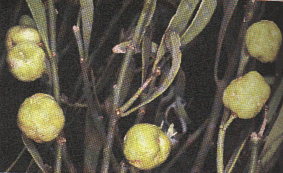
Round lime - Citrus australis
At present, at least 50
bushfoods and bushfood products have been researched, developed
and processed for market, with a further 150 species identified
as having commercial potential. Bushfood products are
now appearing in the general retail market and some have
become household items (Graham and Hart, 1997). Current demand
for many bushfood products outstrips supply.
One interesting group of new
crops to emerge from the rainforests and semi-arid areas of eastern
Australia is the edible native citrus or `wild limes'. Several species of
native citrus have been wild harvested in recent years. "Native citrus
are keenly sought after for use in the
Native Foods Industry, where their excellent culinary and
beverage attributes...are proving to be powerful marketing tools"
(Beal, 1997).
Graham and Hart (1997) in their report of the prospects for
the Australian native bushfood industry included wild limes
(formerly Microcitrus species and Eremocitrus
glauca, now reclassified back into
Citrus) in the fourteen crops with the most commercial potential.
Australian native citrus have a strong potential within both the bushfood and
citrus industries for commercial growers of raw produce and for the
retail (home grower) market.
History
Exotic citrus species were
first introduced into Australia in 1788, by members of the First Fleet.
Six species of native citrus endemic to Australia were described
by colonial botanists. Their potential for cultivation was recognised
as early as 1899, when the colonial botanist, FM Bailey, advised that native citrus was "...well worthy
of cultivation for its fruit, which is juicy and of equal flavour with the
West Indian Lime."
WT Swingle (1915) described the rainforest limes as
"...very ornamental and should become better known for
decorative purposes." Only limited records exist of traditional Aboriginal
use for these native citrus species. Tim Low, in his book "Bush
Tucker" says: "Anthropological records
are so incomplete (in the subtropics) that we cannot even confirm
that Aborigines ate such common fruits as native tamarind..."
However, records do exist that such species as the finger lime were used by
the early settlers for making cordials and marmalade.
Cultivation of native citrus
was largely ignored in Australia until CSIRO began investigating the
use of some of these native citrus species in breeding programs,
in the 1960's. However, the native citrus species were used
primarily for developing new hardy varieties of rootstocks for
Australian conditions and as a source of genetic characteristics to
contribute to improvement of mainstream
Citrus (Sykes, 1997).
Classification
Exotic citrus species have been bred for thousands of years.
Most true citrus species can no longer be located in the wild, as
early cultivation has lead to hybridisation. Hence there is confusion
in attempting to define citrus species, as each variety may be a
complex hybrid of three or even four species. Hybrids can result from
either natural or deliberate interbreeding of related species.
Resulting hybrids may then be given a new botanical name and species
status (e.g. Citrus virgata - the Sydney hybrid), under the International Code of Nomenclature
for Cultivated Plants. This practice is no longer in common use and
new hybrids are referred to as hybrids between the two relevant
parent species.
Thus confusion has arisen in Australia, with the
current commercialisation of both true native citrus species and
`native citrus varieties' (cultivated hybrids between exotic and native
Citrus). There is a lack of standardisation of common names within
the Australian native foods and citrus industries, with the six
different native citrus species and their hybrids often listed under
the general category of `native citrus' or `wild limes'. Until
the industries reach an agreement on the correct identification
of Australian native citrus, botanic names are the only positive
method for identification.
Cultivated hybrids are
generally referred to by their cultivated variety name (`cultivar' name)
or origin, e.g. the `Australian
Blood'PBR lime is a hybrid between a native citrus species and an
exotic citrus variety.
Australian native true citrus species
Until recently, there were two genera of true citrus fruit trees in
There is a lack of standardisation
of common names within the Australian native foods and citrus industries,
with the six different native citrus species and
their hybrids often listed under the general category
of `native citrus'or `wild limes'.
Australia, Microcitrus and
Eremocitrus, both of which are members of the
sub-family Aurantioideae of the family Rutaceae. The rainforest
limes were separated by Swingle (1915) into the new genus
Microcitrus due to the very small juvenile
leaves and the minute size of the flowers. These genera have now
been reclassified by Professor David Mabberley, of the Royal
Botanic Gardens Sydney, back into Citrus.
There are six native species of
Citrus (five endemic) in Australia. Their distribution
originally extended from the Northern Territory, to the Cape
York Peninsula and down the east coast of Australia, to the Clarence
River, on the north coast of New South Wales. Much of this area has
since been cleared for development. For this reason, each species now
has a limited distribution, with two of the species endemic to
Queensland currently listed as rare in the wild.
Citrus glauca is endemic to the semi-arid regions of
Queensland, New South Wales and South Australia and
Citrus gracilis is endemic to the Eucalypt woodlands of the
Northern Territory. Citrus x virgata `Sydney Hybrid" is a
cross between Citrus australis and
C. australasica.
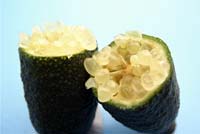
Citrus australasica -
finger lime
The natural distribution of the
finger lime is now from the Richmond River, in northern New
South Wales to Mt Tambourine in Queensland (Floyd, 1989),
with reference to its occurence in the southern portion of the
Moreton Bay district (Ross,1983). It is found growing in
sub-tropical rainforest as an understorey tree with an average height of 6m, on
a range of soil types. The flowers occur singly in the leaf axils in
spring and summer and fruit are born on the previous season's growth
in autumn, on seedling trees. In coastal sub-tropical
regions, flowering and fruiting may occur several times a year, on
grafted trees. Seedlings trees have a long juvenile period of 5-17
years (Sykes, pers. comm., 1997) and few trees bear fruit annually. A
wild population of 25 mature finger limes surveyed by the author, yielded
an average of 186g of fruit per tree, in 1998. Grafted selections
are variable, but generally bear more fruit in their third year than
their mature counterparts in the wild.
The shape of the fruit is
cylindric-fusiform or `finger-shaped', which is unique in the Orange
sub-family. The species has a wide genetic diversity within its
natural distribution and fruit varies considerably in size, shape,
colour, quantity of seed and degree of acidity. The mature skin colours
of the finger lime range between crimson, blood red, purple,
black, yellow and green. The pulp is green on maturity and there is also
a pigmented variety of finger lime, which has an attractive pale
pink to dark crimson pulp on maturity. The red-pulp finger lime,
although previously recorded as having a distribution from Terania Creek,
in New South Wales to Mt Tambourine, in Queensland,
has been observed growing throughout the natural distribution of the
finger lime by the author. Previously unrecorded phenotypes, a
yellow-pulped variety and a green/pink-pulped variety, have also
been identified by the author.
The seed of the finger lime is monoembryonic (Smith, 1996) and seedling trees do not bear
true to type. Size ranges from a small fruit of 6.3 x 1.2cm, weighing
7g at maturity, to a large fruit of 11.2cm x 2.9cm. weighing
60g, suitable for commercial processing. Fruit size varies with
environmental conditions. The fruit contain from five to seven locules and have
the unique characteristic of separate pulp-vesicles (Alexander,
1983). These pulp-vesicles, which have the appearance of caviar,
are compressed within the skin and will burst out on cutting open the fruit.
In their book `Wild Food in Australia', Alan and Joan
Cribb give a delightful description of eating the fruit: "For anyone
who likes sour fruit these pulp cells are delicious; they burst pleasantly
at slight pressure from the teeth and provide a most
welcome refreshment" (Cribb, 1980). The finger limes can be used as a
fresh fruit for garnish and for processing into a wide range of
value-added products, such as salad dressings, beverages, sauces, marmalades
or desserts. They contain up to 82mg of Vitamin C per 100g of
raw edible portion (Miller et al.,1993). Farm gate price ranges from $8
-12.00/kg.
Citrus australis - round lime
Also called the Dooja or Gympie lime, this is the most vigorous
of the Australian native citrus, growing to a height of 9-18m. It is
endemic to south-eastern Queensland from Beenleigh to Gympie, in
lowland sub-tropical rainforest. This species flowers in spring and
bears rounded fruit which are 2.5-8cm in diameter, with a rough
greenish-yellow skin on maturity and pale green pulp. The fruit contains an acidic juice, similar to the
finger lime, but does not have the rounded pulp-vesicles or colour
variation. The round lime is suitable for processing into a range of
value-added products such as cordials, sauces, marmalades and
lime flavouring. The skin is very thick (up to 7mm) and has potential
for culinary use, such as grating into spice pastes, or for candied
peel. The species may also have potential for essential oil
extraction. The round lime fruit currently sell for $8-9.00/kg at the farm
gate (Cherikoff, pers. comm., 2000).
Citrus garrawayae - Mt
White lime
This species is endemic to the foothills and upland rainforest of
the Cook District, Mt White on Cape York Peninsula in Australia
and Goodenough Island in Papua New Guinea. It grows in deciduous
vine thickets as an understorey shrub and has been recorded at a
height of 15m. Due to its limited distribution, this species is
now classified as rare in the wild and is protected under the
Queensland Nature Conservation Act 1992. It is similar to the finger lime,
but has broader leaves (Alexander, 1983). The flowers are
single, axillary and seedling trees bear fruit from April to November
(Cooper, 1994). Grafted trees bear flowers in Spring and fruit in Autumn.
The fruits are also `finger-shaped', with a green skin and greenish-white
to pale pink pulp on maturity. The fruit have fewer cells than the
finger lime and a thicker skin (up to 2mm) containing large oil glands
and weigh an average of 25g. The fruit may be used for processing into
a range of value-added products, as for the round lime. The Mt White lime fruit have not yet been
traded commercially (Ringer, S, pers.comm.2000).
Citrus inodora - Russell
River lime
Also called the large-leaf Australian wild lime, this species
is endemic to the lowland rainforest between Cairns and Innisfail,
in north-eastern Queensland. It is a small tree, with an average
height of 2-4m and differs from other species of native citrus by
the presence of twin spines in each leaf axil and absence of perfume in
the flowers (hence the name inodora). The fruit are green on maturity,
oval (somewhat lemon- shaped) and up to 6.5 x 3.2cm in size
(Alexander, 1983). This species is also classified as rare in the wild and
is protected under the Queensland Nature Conservation Act
1992.
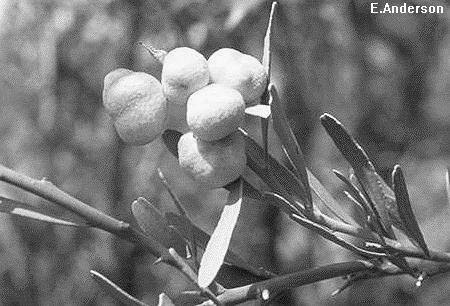
Citrus glauca - Desert lime
Also known as the limebush or desert cumquat, this species
was the `wild lime' featured in the Australian cookbook of the
same name. The botanical name of this species is derived from
eremos, the Greek word for `desert' and
glauca, meaning `bluish', referring to the blue-grey colour of
the leaves. The natural distribution of this species is the semi-arid
regions of eastern Australia, from Rockhampton to Longreach
in Queensland, south to Dubbo in central New South Wales
and west to Quorn, in the Flinders Ranges of South
Australia (Alexander, 1983). The desert lime is the only pronounced
xerophyte in the orange subfamily, is extremely drought tolerant
and able to withstand extremes of hot (45ºC) and cold
(-24ºC) temperatures (Swingle and Reece, 1967). In its natural habitat of inland woodlands and brigalow scrubs, it is found growing on
a range of soil types, especially heavy clay soils. (Low, 1988). The
tree varies in size and form, from a dense multi-stemmed thicket of
2-3m in height, to a taller, more upright tree of 12m. The fruit
is round to oblate in shape and approximately 2cm in
diameter, weighing from 1-3g. The skin is a light yellow-green on maturity
and contains large oil glands. The flower to fruiting time is the shortest of
any citrus species, being from 10-12 weeks (Sykes, 1997). The
species flowers mainly in spring and fruits ripen in summer. The acidic fruit
is often seedless and can be used whole in cooking, or for
processing into a range of value-added products, such as
marmalades, sauces and cordials. The desert lime currently sells for $7.00/kg
at the farm gate (Cherikoff, pers. comm., 1998).
Citrus gracilis - Humpy Doo lime
Also known as the Kakadu lime, this species has recently
been formally described and named by Professor David J. Mabberley
of the Royal Botanic Gardens Sydney. Named
gracilis because of its graceful foliage, the
species has a similar habit to the Citrus
glauca. It is a straggling tree of up to 4m in height and bears
pinkish-white flowers. It has characteristic large rounded fruits, of up to
8cm in diameter, which contain many locules. This fruit is recorded
as having been eaten by Aboriginal people (Mabberley, 1998).
The habitat of this species is Eucalypt woodland, with a
grassy understorey on sandy or gravelly soils. As yet, little is known
about the commercial potential of this species.
Hybrids
Citrus x virgata - `Sydney
hybrid' (Citrus australis x Citrus
australasica)
An example of a hybrid native citrus grown from seeds of
the round lime and the finger lime by the US Department of
Agriculture and given species status. The fruits of this species are similar to
a lemon in shape, 35-50 x 20-28mm in size, with the tip
abruptly rounded. The skin is 2mm thick and yellowish-green when
ripe, containing numerous oil glands and the pulp-vesicles are
tear-shaped (Swingle and Reece, 1967).
Cultivated hybrids
The following two
open-pollinated citrus seedlings have recently
been released by CSIRO to the bushfood industry for
commercial experimentation and development.
`Australian Blood' PBR
lime
This is a selected hybrid
produced by open-pollination. It is thought to be a cross between an
Ellendale mandarin (a mandarin and orange hybrid) and a seedling form of
the Australian red-pulp finger lime (Citrus
australasica) (Lewis, B, pers. comm., 1997). The cross
has produced a tree of 2-3 metres in height, which bears small,
blood-red fruit of approximately 30-50mm x 20-30mm (about the
size of an oval cumquat). The pulp of the fruit is pink in colour,
the intensity of which varies from season to season, however,
the fruit do not have the separate rounded pulp-vesicles as found
in the finger lime (Sykes, pers. comm., 1997). The
`Australian Blood' PBR lime flowers in
spring and fruit ripens in winter. The fruit is suited to manufacturing into
a range of value-added products, including beverages,
preserves, marmalades, sauces and syrups (Beal, 1998).
`Australian Sunrise'
PBR lime (Citrus australasica x
(Fortunella sp. x Citrus reticulata `Calamondin')
This variety is an open
pollinated seedling selected from a Faustrimedin (Sykes,
1997), which is a hybrid of the finger lime with the calamondin; itself a
hybrid between the cumquat and some variety of orange of the
mandarin group (Citrus reticulata). The Faustrimedin is thus a
trigeneric hybrid of Fortunella, Citrus
and Citrus australasica and was originally bred in California in
1911 (Swingle and Reece, 1967). This hybrid citrus variety flowers
in spring to early summer and fruit ripens in winter. The fruit are
pear-shaped, approximately 30-45mm x 20-40mm, with a
yellow-coloured skin on maturity. They are suited to manufacturing into a
range of value-added products, as for the `Australian Blood'
PBR lime (Beal, 1998).
Australian Native Citrus Propagation
All Australian native citrus
species can be propagated from seed, although germination from seed
of Citrus australasica is erratic (Floyd, 1989). Due to a
wide genetic diversity, monoembryonic seed and compatability with
exotic citrus varieties, Citrus
australasica seedlings do not bear true to type. Cuttings are slow
to strike (up to 6 months on a heat bed) with a 50% strike rate
and both seed and cuttings may take many months to develop
root systems (Nicholson, 1985). Seedling trees of
Citrus australasica bear fruit from 5 to17 years (Sykes, pers.
comm.,1997) and "Slow growth rates are frustrating..." (Nicholson,
1985). Seedlings of Citrus glauca grown under irrigation in California,
began to flower and set fruit at 8-10 years old and reached a height of
5m after 7 years (Swingle and Reece, 1967).
Citrus species are now almost universally propagated by
budding onto citrus rootstocks. Trees are selected with superior qualities
and reproduced clonally by grafting buds (`budding') from the
original parent trees onto selected citrus rootstocks. This enables trees
of distinct, uniform and stable qualities to be cultivated. Because the
scion is selected from mature trees, budding short-cuts the
long juvenile period and enables trees to bear fruit in their second or
third year in the ground.
Native citrus species appear to
be compatible with Citrus and when grafted onto rootstocks they
grow quite vigorously, forming smooth unions (although some
graft incompatibilities with Citrus glauca have been reported (Bitters
Citrus species are now almost
universally propagated by budding onto citrus
rootstocks. Trees are selected with superior qualities
and reproduced clonally by grafting buds
(`budding') from the original parent trees onto selected
citrus rootstocks. This enables trees of distinct,
uniform and stable qualities to be cultivated. et al., 1964)). Rootstocks may be selected to suit soil type
and climatic conditions. The process of budding native citrus
species requires greater skill than for
exotic citrus species, due to the minute size of the buds and high
losses may be experienced. However, the result is a tree of increased
vigour and disease resistance, which can flower and set fruit at an early
age and provide a more reliable yield of high quality fruit.
Australian Native Citrus
Breeding Programs
Dr Steve Sykes, from the CSIRO Division of Horticulture
at Merbein, has been crossing native citrus with exotic citrus hybrids
and researching the breeding of both new rootstocks and citrus
scions. Citrus australasica and Citrus
australis were used for their dwarfing characteristics and
the red-pulped fruits of Citrus
australasica were used for breeding new pigmented
varieties of Citrus. Citrus glauca was
used for cold hardiness and resistance to salt and boron toxicity. He has since recognised a potential
for some of these new hybrid varieties of
Citrus to be cultivated for their ornamental qualities
(Sykes, 1997).

An assortment of limes- photo Erika Birmingham
Dr Sykes has released a selection of Citrus glauca
`Australian Outback'PBR, as well as the `Australian Blood'
PBR lime and `Australian
Sunrise'PBR lime to Australian Native
Produce Industries Pty Ltd, of South Australia, for
commercial development. These varieties have currently been granted
Interim Protection by the Plant Breeders Rights Office in Canberra.
CSIRO is now focusing primary research on breeding new citrus
varieties and plans to conduct further breeding programs with
the `Australian Blood'PBR lime, aimed at increasing the fruit size of
the hybrid citrus varieties (Sykes, 1997).
Other plant breeders have also emerged, who are breeding
and selecting a range of superior true native citrus species
for commercialisation. The author has collected seed and
propagating material from throughout the natural distribution of native citrus
species for ex situ conservation and breeding programs. Fifty
varieties of native citrus have been selected from a wide gene pool of
seedling trees. These have been grafted onto different rootstocks for
long-term evaluation in trial plantings and to determine
scion/rootstock compatibility. Superior varieties
are being assessed for the following criteria: vigour, tree habit,
fruit yield, ease of propagation, pest and disease resistance and a
range of fruit qualities, such as skin and pulp colour, flavour,
size, seedlessness and skin thickness. Interim Protection has
been granted by the Plant Breeders Rights Office in Canberra on
a variety of finger lime (Citrus
australasica) `Rainforest Pearl'PBR, currently available
from AT Eyles and Sons P/L in NSW and Victoria and
Birdwood Nursery in Queensland.
Conclusion
In Australia, we are fortunate
to have a valuable genetic resource in wild populations of true
native citrus species. Our native citrus have been exported to
many countries over the last century, where they remain in arboretums, but represent limited
genetic diversity. Biodiversity of native citrus species is
currently diminishing in the wild, due to continued clearing for
development and other environmental pressures, with two species already placed
on the rare and endangered list. This diminishing genetic resource
should be protected by both in situ and ex
situ conservation of these species for protection
of biodiversity and for use in future breeding programs.
Limited funding has restricted
the research and development of our unique Australian crops and
the research base is small and fragmented.
Government departments are currently funding a narrow range of native
food crops, prioritising the development of existing products and markets.
More emphasis must be placed on adequate resources for R&D
of Australian native food crops, the value of which can be measured
in cultural, economic and environmental terms. Let us
not repeat the mistakes of the Macadamia Industry, where
the Australian `bush nut' was introduced into Hawaii in
the 1880's, cultivars developed for Hawaiian conditions from a
limited genetic diversity and then returned to Australia, only to find they
did not perform well here (Bell, 1995).
In Australia, we need to acknowledge the largely untapped genetic resource of native
citrus from the rainforest to the desert. More emphasis should be
placed on the conservation of our native citrus species
ex situ. Citrus growers in Australia now have
the opportunity to commercialise our Australian native citrus species
for their unique qualities and in doing so, to help preserve our
natural heritage.
ã Erika Birmingham, 2000
Byron Bay Native Produce
Telephone: 02 6687 1087
Facsimile: 02 6687 1087
International facsimile: 61 2
6687 1087
Email: erikab@nor.com.au
References
Alexander, DMcE (1983) Some Citrus Species and Varieties
in Australia. CSIRO Publishing, Melbourne.
Bailey, FM (1899-1902) The Queensland
flora. Vols 1-6 HJ Diddams & Co, Brisbane.
Beal, A (1997) Australian
Blood Lime PBR. Australian Native Produce Industries Pty Ltd.
Beal, A (1998) Commercialisation of
Native Citrus. The Australian Rainforest Bushfoods Industry
Association Technical Journal 6.
Bell, HFD (1995) Plant
Breeding in Vegetatively Propagated Tree
Crops. Proceedings from the Sixth Conference of
ACOTANC, Lismore, NSW. Available from:
http://www.uq.edu.au/~gagkrego/acotanc/papers/bell.htm
Bitters, WP, Brusca, JA and
Cole, DA (1964) The Search for new citrus
rootstocks. Calif. Citrograph, 49, 443-8.
Brand Miller, J, James, KW and
Maggiore, PMA (1993) Tables of Composition of
Australian Aboriginal Foods. Aboriginal Studies Press.
Cooper, W (1994) Fruits of
the Rain Forest. RD Press, Australia.
Cribb, AB and JW (1980) Wild Food in
Australia. Fontana/Collins Publication.
Floyd, AG (1989) Rainforest Trees of Mainland
South-eastern Australia. Forestry Commission of NSW.
Graham, C and Hart, D (1997)
Prospects for the Australian Native Food
Industry. Rural Industries Research and Development Corporation, ACT.
Low, T (1988) Wild Food
Plants of Australia. Angus and Robertson, Australia.
Mabberley, DJ (1998)
Australian Citreae with notes on other Aurantioideae
(Rutaceae). Telopea 7(4):333-344.
Nicholson, N and H (1985-9) Australian Rainforest
Plants. Hugh and Nan Nicholson, The Channon, NSW. Volumes 1-4.
Ross, EM (1983)
Rutaceae. In Stanley, TD and Ross, EM
(1983) Flora of South-eastern Queensland 1:
440-470. Government Printer, Brisbane.
Smith, K (1996) Comparative Embryology of
Microcitrus australasica and Microcitrus australis.
University of New England, Armidale.
Swingle, WT (1915)
Microcitrus, a new genus of Australian citrus
fruits. Journal of the Washington Academy of Science 5: 569-578.
Swingle, WT and Reece, PT (1967)
The botany of Citrus and its wild
relatives. The Citrus Industry Vol. 1. University of
California, Division of
Agricultural Science, USA pp190-430.
Sykes, SR (1997) Australian native limes
(Eremocitrus and Microcitrus); a citrus
breeder's viewpoint. Australian Bushfoods Magazine 3.
Citrus glauca - Wild
lime. Photo Brian Rogers
Erika Birmingham
Byron Bay Native Produce
Australian finger lime specialists since 1995.
PO Box 232, Bangalow, NSW 2479
Ph/Fax (02) 6687 1087
Email: erikab@nor.com.au |